Contingent labor is now a critical part of workforce strategy - but many organizations still don’t know exactly what they’re spending.
In fact, nearly 60% of contingent workforce spend goes untracked, leaving businesses exposed to hidden costs, inconsistent rates, and missed savings opportunities.
If you can’t clearly answer “What are we spending on contingent workers this year?” - you’re not alone. But it’s also a major risk.
Almost 60% of contingent workforce spend goes untracked
Many businesses, especially those with smaller volumes of contingent workers, often lack the necessary management practices, technology, or processes to effectively capture and monitor all their contingent workforce spend.
In fact, according to a study by Ardent Partners, nearly 60 percent of contingent spending goes untracked in financial planning, forecasting, and budgeting in the average organization.
Why is this important, and how can your organization achieve full visibility and control over contingent workforce spending?
The Hidden Problem: Untracked Contingent Workforce Spend
As companies scale their use of contractors, temps, and agency workers, spend becomes harder to track.
Common challenges include:
- Disconnected spreadsheets across departments
- Hiring decisions made outside centralized processes
- Inconsistent bill rates across locations
- Vendor invoices that aren’t validated against contracts
- Workforce data stored in emails instead of systems
The result? A fragmented view of your workforce - and your costs.
Why do Many Companies Lack Spend Visibility?
Large Enterprises
For large enterprises, contingent workforce programs are often managed by dedicated teams or MSPs. Rogue Spend isn’t an issue for large enterprise organizations which have the resources to hire either specialized internal teams or outsourced contingent workforce MSPs specifically designated to manage their contingent workforce program.
Mid-Market
But for Mid-Market organizations and growing companies:
- Processes are manual
- Technology is limited
- Visibility is fragmented
Many rely on spreadsheets, which:
- Create duplicate or conflicting data
- Are prone to human error
- Don’t scale with workforce growth
These spreadsheets are vulnerable to human error, they get saved in multiple locations across different departments leading to inaccurate figures, inefficient processes and rates that aren’t standardized, and they even get lost.
The result? Contingent workforce data is saved across a number of spreadsheets under the same name, with no one in the organization knowing which is the right document to use. Even worse, contingent workforce information is only saved through emails, and never even entered on the spreadsheet in the first place.
With no centralized place for contingent workforce data to be saved, businesses completely lack visibility into their contingent workforce spend.
Without a single source of truth, accurate spend tracking becomes nearly impossible.
Why Not Knowing Your Contingent Spend is Costing You
Lack of visibility doesn’t just create confusion - it directly impacts your bottom line.
Key Risks:
- Rogue spend (unapproved or off-contract hiring)
- Overpaying for talent due to lack of rate benchmarking
- Inconsistent vendor pricing across locations
- No accountability for vendor performance
- Inability to forecast or budget accurately
Questions You Should Be Able to Answer:
- Are we paying market rates?
- Are vendors following agreed rate cards?
- Where is spend increasing - and why?
- Which vendors deliver the best value?
- Are we compliant with worker classification laws?
If you can’t answer these confidently, your spend is likely out of control.
Using a Vendor Management System gives your business the visibility and control it needs
Are you looking for a better, and cost-effective, solution that gives your business complete visibility into contingent workforce spend so that you can make program changes that reduce costs and improve workforce quality?
That solution comes in the form of a vendor management system.
A vendor management system (VMS), is a cloud-enabled software platform that centralized and automates the entire lifecycle of managing contingent workers and staffing agencies - from source to pay.
By consolidating all of the processes and data associated with contingent workforce management into one central location, businesses gain complete visibility into their contingent workforce spend and where program improvements can be made.
How a vendor management system gives you visibility into your Contingent Workforce Spend
A VMS enhances visibility into contingent workforce spending by centralizing data, automating processes, and offering real-time insights into costs, performance, and spending trends, ultimately facilitating better decision-making and budget management.
1 - Centralized Data and Reporting
A VMS serves as a single source of truth for all contingent workforce information, including worker details, project assignments, time and expense tracking, and vendor performance data.
This centralized data supports comprehensive reporting and analysis, allowing you to track spending by project, vendor, skill type, and other relevant categories.
A VMS enables the creation of dashboards and reports that provide a clear overview of contingent workforce costs and trends.
2 - Automated Processes and Reduced Errors
A VMS streamlines processes such as requisition management, onboarding, time and expense tracking, and invoice processing, reducing manual effort and potential errors.
Automated workflows ensure accurate data capture and timely payments, enhancing efficiency and reducing administrative overhead.
3 - Real-Time Insights and Spend Optimization
A VMS offers real-time visibility into contingent workforce costs, enabling you to identify potential cost-saving areas and optimize spending.
By tracking spending trends and analyzing vendor performance, you can make informed decisions about vendor selection, contract negotiations, and resource allocation.
A VMS can help you understand bill rates, pay rates, and margins, facilitating data-driven negotiations with vendors.
4 - Enhanced Compliance and Risk Management
A VMS helps ensure compliance with labor laws and regulations by tracking worker information, contract terms, and payment schedules.
It also aids in risk management by providing visibility into vendor performance, compliance, and potential liabilities.
5 - Integration with HCM and Financial Systems
A VMS can integrate with Human Capital Management (HCM) and financial systems, offering a comprehensive view of your entire workforce, including both employees and contingent workers.
This integration allows for seamless data sharing and reporting, improving accuracy and efficiency.
The Business Impact of Spend Visibility
Organizations that gain control of contingent workforce spend typically achieve:
- Up to 20% cost savings
- Improved vendor performance
- Faster decision-making
- Better workforce planning
Most importantly - they move from reactive to strategic workforce management.
Final Thoughts
If you don’t know what you’re spending on contingent workers, you’re not in control of your workforce - you’re reacting to it.
In today’s environment, visibility isn’t optional. It’s the foundation for cost control, compliance, and smarter workforce decisions.
Learn more about the Benefits of a VMS - Free Guide
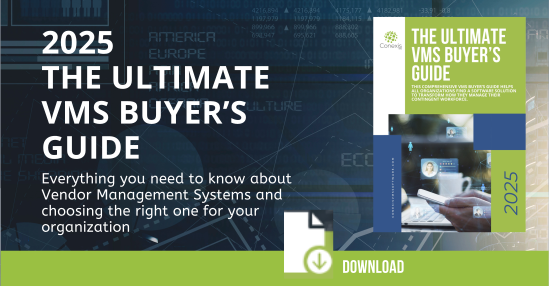
Learn more about the Benefits of a VMS and what to look for when choosing the best VMS for your organization. Download our Free VMS Buyer's Guide here:
Additional Reading
Everything You Need to Know about VMS Cost Savings | Guide
Funding Your VMS:
Cost and ROI of a VMS
- How Much Does a VMS Cost?
- A Quick Overview of Vendor Management System Pricing
- Maximize ROI: Top 4 Vendor Management System Best Practices
- VMS ROI: What Size of Operation Do You Need to Make a VMS Worthwhile?
- Vendor Management Software: What's the Cost & ROI?
- What Size of Operation Do You Need to Make a VMS Worthwhile?
- 5 Best Practices to Optimize your Vendors and Maximize ROI
- Save money with Conexis VMS flexible pricing
- 10 Questions to ask a VMS Provider about Cost and Pricing
Cost Per Hire
Staffing Agencies
- 5 Ways a VMS Reduces Staffing Costs with Smart Rate Card Management
- Staffing Agency Bill Rate: What is it?
- Staffing Agencies: How a VMS can increase your Revenue
MSPs
Government
Contingent Workforce Spend & Cost Reduction
- How to Save 20% on your Contingent Workforce Cost with a VMS
- How a VMS Lowers Contingent Workforce Costs
- How to Manage Contingent Workforce Rogue Spend
- Driving Spend Under Management in a Contingent Workforce Program
- 4 Ways to use your VMS to Control Contingent Workforce Cost and Save Money
- 4 Ways to Gain Control of Your Contingent Workforce Spend
- How a VMS helps you Control Costs during Market Uncertainty
- Why Spreadsheets may be costing you millions in Contingent Labor Spend
- Do you know what you're spending on Contingent Workers this year?
Conexis VMS Case Study
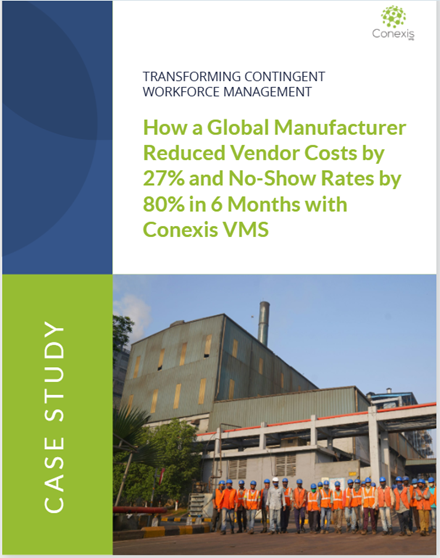
Case Study: How a Manufacturer Cut Costs by 27% and No Shows by 80% with Conexis VMS
About Conexis VMS
Conexis is an award-winning Vendor Management System built for organizations that want the power of enterprise software without the complexity or cost.
Leveraging the latest technology, Conexis delivers the expertise, reliability and security of enterprise systems, while offering the flexibility, user friendliness and tailored, personal service you require. Learn more about our Company and why organizations Choose Conexis VMS.
Why Leading Companies Choose Conexis VMS
Conexis VMS is purpose-built for organizations seeking to manage their contingent labor spend effectively. Here’s why we're the right choice:
- Our Advanced Technology: We have the most modern and advanced VMS tech stack available today starting with the latest codebase and extending to our lightning-fast AWS microservice
- Fast Deployment: Get up and running in weeks, not months
- Transparent Pricing: Flexible pricing with no hidden costs and no set-up fees
- White-Label Ready: Customize the platform with your brand
- Real-Time Insights: Make faster decisions with built-in analytics
- Audit-Ready Compliance: Store contracts, worker data, and rates in one secure hub
- Open APIs - Effortless Integrations: Connect Conexis VMS to your ATS, HRIS, Finance, or BI systems in record time. Enjoy seamless data flow and instant visibility across all your tools
Looking to Switch Your VMS or Just Getting Started?
Whether you are looking to switch your VMS, or just getting started, we are here to help. Contact Us for a Free No-Obligation Consultation, See how Easy Conexis is to use by taking a quick 2 minute Self-Guided Online Demo, or Book a Personal Demo Today!
 |
 |
 |


.png)
 Read More